
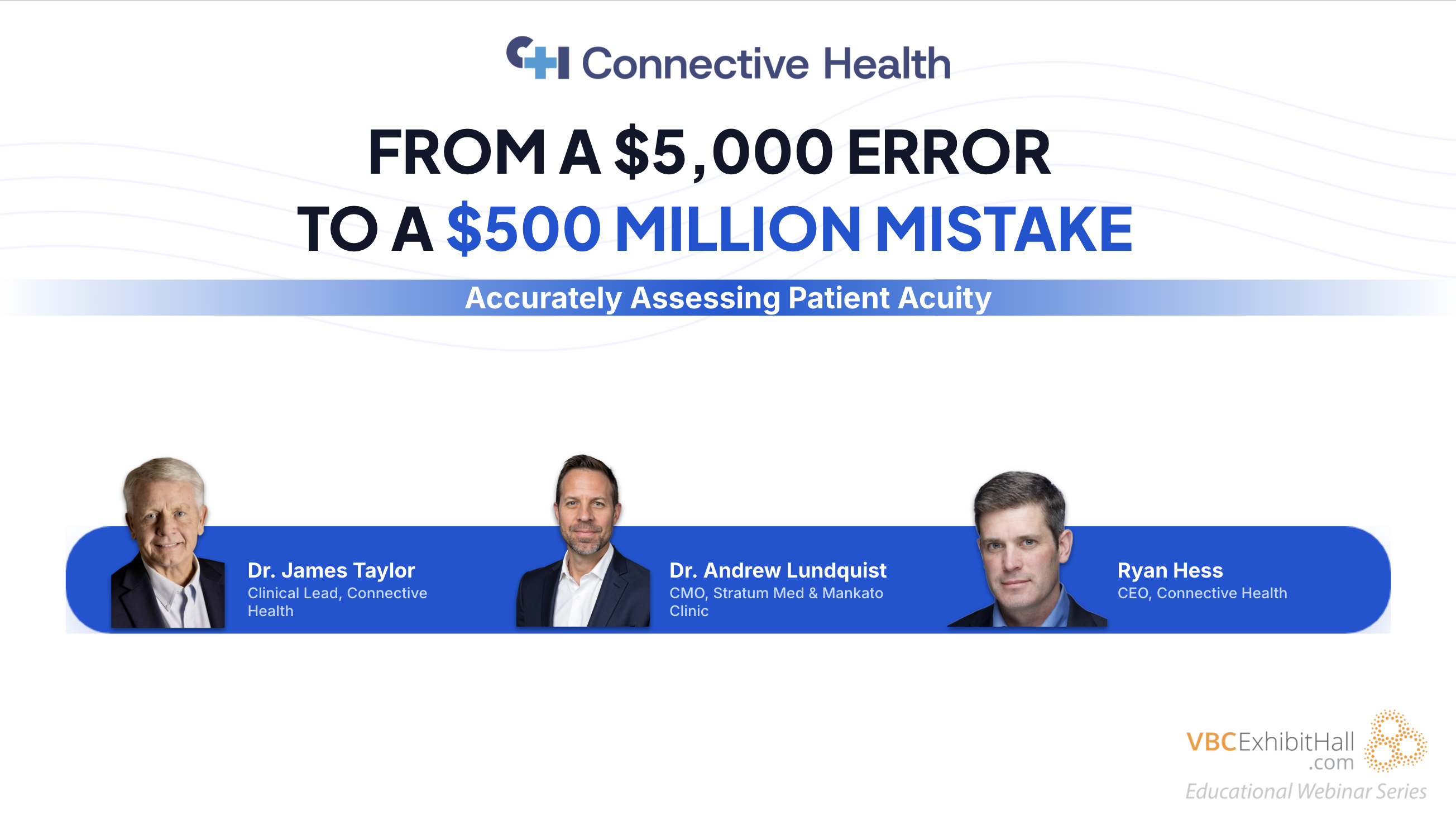
Welcome and Introductions
Garrett Schmitt: Hello everybody. Good morning or good afternoon, depending on where you are in the country. My name is Garrett Schmitt, and I'm the CEO and managing editor of VBC Exhibit Hall. I'd like to welcome you all to today's live webinar, hosted by Connective Health: "From a $5,000 Error to a $500 Million Mistake: Accurately Assessing Patient Acuity." This is such an important topic, and I'm excited to hear from our speakers today.
A few notes before we get started. Everyone has joined in listen-only mode, so this is a traditional webinar format — you don't need to worry about your camera or microphone. We'll have time for audience Q&A at the end, so drop your questions into the module as we go; we'll get to as many as we can. We'll also run a couple of anonymous polling questions along the way, just for fun, and we'll share the results live.
Lastly, we're recording today's session. About an hour after we wrap, you'll receive an email with a link to the recording, which you're welcome to share with colleagues. There will also be a place to download the slides, which have some useful reference material and links.
Without further ado, let me introduce our speakers. We have Dr. James Taylor, clinical lead at Connective Health, who has 30 years of clinical experience including executive leadership roles at Kaiser Permanente. We also have Dr. Drew Lundquist, chief medical officer of Mankato Clinic, who also leads clinical and compliance strategy for Stratum Med, a group of physician-owned multi-specialty groups. And finally, Ryan Hess, CEO of Connective Health, who will be hosting today's conversation on accurate, compliant risk adjustment and acuity documentation. Welcome, gentlemen.
Dr. Lundquist: Hey everyone. Drew Lundquist, chief medical officer at Mankato Clinic. I also have a role with Stratum Med, a group of physician-owned multi-specialty groups — moving fast some days, less so others, but happy to be part of this. Thanks for having me. I'll pass it to Dr. Taylor.
Dr. Taylor: Jim Taylor. I'm a family physician. I started in a small farm town in Ohio for eight years — delivered babies, first-assisted on surgeries, all the classic small-town family practice work. Then I moved to Denver and joined Kaiser, where I spent 20 years, several of them as a family physician in the clinic before moving into leadership roles, eventually becoming medical director of our Medicare Advantage program.
After Kaiser, I helped a company called Iora Health start up their Medicare Advantage plan, worked for Humana for a while, and now I consult. I have a strong interest in artificial intelligence, mainly because I think we need to get this right — to make the right thing to do the easy thing to do for physicians who have to handle all the documentation. I'm also a certified coder, an ICD-10 trainer, and an Epic-certified physician builder — a jack of many trades.
Ryan Hess: Thank you, Dr. Lundquist. Thank you, Dr. Taylor. I'm Ryan Hess, CEO of Connective Health. Thank you all for being here. My job is basically to make these two gentlemen — and providers everywhere — more effective at their jobs by giving them tools. My passion is sourcing outside data and using AI and other analytics to distill it down into something a physician can actually use when engaging with a patient.
One of the areas we've chosen to focus on is patient acuity — making sure doctors have a full understanding of a patient's acuity as they're treating them. That's the focus of today's presentation. We'll cover four sections: first, defining patient acuity and why it matters; second, the tools available today to assess it; third, common pitfalls, and how those lead to a $500 million mistake; and fourth, how AI impacts all of this. I'll hand it to Dr. Taylor to start us off on the baseline of patient acuity in primary care.
Part 1: Defining Patient Acuity
Dr. Taylor: I'd like to start with the evolution of the chart. I started my practice back in 1987, eight years in Ohio. Those were the "good old days" in the sense that we could check a box on a superbill and document a patient in nine or ten words.
[Note: a portion of Dr. Taylor's remarks on early documentation practices was not captured in this recording.]
Getting the acuity right seems like it's just a business function, but it's actually fair — it helps you negotiate if you're in independent practice, and if you're in a larger company with panel-size restrictions based on acuity, it's important to document correctly in a way that actually gets picked up in the data, so you get accurate reporting.
Ryan Hess: I love tracking how patient acuity affects things from the very beginning, like panel size. Dr. Lundquist, from a chief medical officer perspective across an MSO like Stratum as well as a fast-moving clinic like Mankato, how do you see patient acuity impacting your day-to-day?
Dr. Lundquist: I'm jealous of whoever could document in the fewest words — I started practice in 2007 with paper charts, and I remember one note that just said "fussy baby, Tylenol PRN." That was the whole note.
We exist in a very different world now. The acuity of our patients and the risk scores we need to attribute to them matter a great deal. As a multi-specialty group surrounded by other larger multi-specialty groups, we don't always have all the data at our fingertips, and that's one of the things Connective Health helps us with — making sure what the patient says matches what they actually have, and what's documented.
This has been a journey for us. We're part of an ACO, part of contracts with downside risk like everyone else, and as a physician-owned multi-specialty group, we need our clinicians to have the data they need to see patients and attribute the right diagnoses — and to do that correctly so we can keep our doors open. We've tried to break out primary care acuity from specialist acuity as an organization, with varying levels of success.
Ryan Hess: A couple of fascinating parts there — patient-reported information matching the clinical record, and making sure specialists are trained to capture acuity and get the full picture of the patient. This has also become part of the reimbursement fabric, in a more sophisticated way now, with things like HCC coding and risk adjustment scores. Dr. Taylor, I know you've heard about CMS shifting focus toward not just the complexity of the patient, but the quality of the coding for that complexity. What's your perspective?
Dr. Taylor: Back in the day, we'd check boxes with CPT codes, send them to an insurance company, and get paid. Occasionally we'd get audited to confirm medical necessity. HCCs — hierarchical condition categories — are really the new CPT codes that require medical necessity documentation.
I went to a seminar recently where three attorneys spoke, and they said what they're really looking for is: did you document it to get the dollars, or did you document it because you're giving good patient care? There has to be documentation showing, for example, that a patient's diabetes hasn't been addressed in six months and needs an A1C — rather than just "diabetes, stable." You're doing that because you want to care for the patient, not just to report the diagnosis so the health plan gets paid.
Ryan Hess: Dr. Taylor, I have a question. We've always told our clinicians to click on diagnoses that affect their care — for example, a podiatrist seeing a diabetic patient before surgery would click on diabetes with complications because it affects the plan of care. Can you speak to how that helps patients and organizations, or where it might go too far?
Dr. Taylor: What you're describing is actually following coding guidelines. As a certified professional coder and certified risk coder, I know they use the acronym MEAT — measured, evaluated, assessed, or treated. If you're assessing that elevated kidney function and diabetes will impact healing after surgery, that's impacting patient care, so doing what you're doing is exactly right.
As an old physician, it can feel like a "duh" — of course they're diabetic, of course their creatinine is elevated — but you do have to justify your thinking now. It doesn't have to be a paragraph. In primary care, if I'm treating a diabetic patient's cellulitis with two antibiotics because I need to double-cover them, I'll just note "antibiotic A and B due to DM." That one line ties it together and avoids a query later asking why two antibiotics were used. I tell the doctors I train: give me five seconds now, or five minutes later.
Dr. Lundquist: That's often the key — we click on a diagnosis but don't line it up in the plan. That's where I find my own notes sometimes lacking.
Dr. Taylor: Right — in a surgeon's case, you'd just state "we'll continue to monitor DM and hypertension." That shows you thought about it, and that's enough to demonstrate it impacted the patient's condition.
Part 2: Tools for Assessing Patient Acuity
Ryan Hess: As we think about getting the full picture of the patient, there's a wealth of tools out there. Dr. Lundquist, I follow you on LinkedIn, and you're always on the leading edge of adopting new tools. What are you finding most helpful in gathering patient acuity today?
Dr. Lundquist: One of our lower-tech tools is a previsit planning sheet that flags gaps we may need to cover with a patient. Over the next couple of months, we're looking to add Connective Health data there — pulled from outside organizations — to line those things up, like a suspected outside diagnosis we don't have in our own chart. That helps provide the whole picture of the patient.
We also use an AI scribe (we use Nabla), which captures visit discussions and ties the plan together in a very thoughtful way. It's easy to forget details when documenting from memory, but with the scribe, we're not looking at a screen, we're having a real conversation, and it all gets documented. I find myself spending less time documenting and more time asking the extra questions I normally wouldn't have time for.
Previsit planning is something we monitor continually and do well on. External record collection is always a bit of a black hole, no matter what system you're in. Tests and diagnostics — we try to pull those in from other sources, but a lot of times you don't know what you don't know with external records.
Dr. Taylor: Even in the paper-chart days, if a hospital record wasn't buried under a doctor's desk, there was no way you'd get hospital records quickly, even weeks later. A lot of times we'd just have to ask the patient what they remembered about their hospital stay. So having information available quickly is a huge advantage now that systems exist to procure it for you.
Ryan Hess: This is a recent survey from the Journal of American Medicine. It's both heartening and disheartening: about 1 in 10 providers feel they can now get a chart that might previously have been buried in a paper cabinet somewhere — but 87% still feel that's not viable. That's the gap we're working to close. You can get outside medical records now, but a lot of the work is distilling the full stack of records down to the three or four chronic conditions you may not know about for that patient. That's the specific problem Connective Health is trying to solve, using interoperability, AI, and analytics.
Dr. Lundquist: The barrier that jumps out to me is "too difficult to use within clinical practice." That's really the key. There are so many tools out there, but if they don't fit the correct workflow, if they make clinicians log into something separate, they're just not going to use it — nobody has time for that. Finding a tool that works within the clinician's existing workflow is critical, because clinicians are very good at quiet-quitting a tool that doesn't fit. You give them a well-designed tool built by someone in administration who doesn't know the workflow, and they'll try it once, it'll take too long, and they'll never use it again — and you may be paying for a tool nobody uses.
Dr. Taylor: When I joined Kaiser in 1995, one of the reasons I joined was that they were building their own electronic medical record, and I became part of the informatics team. One of my rules when building something: physician clicks are currency. If it takes too many clicks, most doctors simply won't do it, or they won't remember the sequence. The more things are pre-researched for them, the more likely they are to use the tool. With physicians, trust is the secret sauce — if you don't put forward easy, trustworthy information, you'll lose their trust.
Ryan Hess: Easy and trustworthy — that's a good framing for how this all needs to work. Physicians have incredibly hard jobs; the technology should be easy and trustworthy for them.
Audience Poll #1
Question: What are the most important tools/processes you have today to assess a patient's acuity? (Choose your top two.)
Results, in order:
- Visit discussion (patient in the room)
- Previsit patient engagement
- External record collection
- Tests
Ryan Hess: It's interesting that we're still relying so heavily on previsit patient engagement, and not as much on what previous providers have said — which speaks to Dr. Taylor's point that if it's not easy and trustworthy, people won't use it as much.
Dr. Lundquist: That validates the discussion we just had. It also shows that AI scribing tools are a bit of a gateway drug to AI in healthcare — people already know what a scribe is, which is probably why it sees the most uptake.
Audience Q&A: Documentation Templates
Audience question: How does everyone feel about documentation templates — pros and cons?
Dr. Taylor: It depends. Coders tend to hate them because they're pre-populated and don't really reflect what you're doing. I used them for some things, but especially in primary care, there's rarely a template for "diabetes review, a sore left elbow, and a husband driving them nuts." If a visit is single-purpose, a template can work, but often they're too hard to use, and pre-checked boxes can imply work you didn't actually do.
At Kaiser, on the informatics team, we actually held a "documentation Olympics" — timing people who typed fast, people who were great with templates, and people who used a mix of smart phrases and other tools. The mixture won. I think AI would win it hands down today. Templates force you to think about or document things that might not be necessary, so I've never been a big fan, though I did use some.
Dr. Lundquist: As a proceduralist, I use AI more than templates now, because it tells the story better — and if I do use a template, I add in the color from the actual discussion, otherwise it looks like every other note. That validates Dr. Taylor's point: the winner is really an amalgamation of tools.
Ryan Hess: Follow-up for both of you — do you find yourselves spending a lot of time reviewing AI output for accuracy? Is that a time cost, or is it worth it given the efficiency?
Dr. Lundquist: For me, it's a little bit of time, but it's justified because it creates a quick note you can skim and then add to. The real question is whether you actually check it — we do see notes slip through with errors that clearly weren't reviewed. But that's not a new problem; it's the same issue we've always had with providers who don't read their dictations before signing off.
Dr. Taylor: It's a different technique producing the same old problems. Back in residency, I kept a collection of funny things transcriptionists thought I'd said — and if I didn't read it, I'd sign it and that would be it. Same with AI: either you read it or you don't, and what's in there is in there. You have to be cautious about what you sign.
Part 3: Common Pitfalls — The $500 Million Mistake
Ryan Hess: Sometimes things go awry, starting with small mistakes and building into very large ones. Dr. Taylor, how did Kaiser Permanente end up facing a $556 million claim? Did it start small and snowball over time?
Dr. Taylor: That situation took up 12 years of my life — this will only take a couple of hours to explain. Kaiser is a genuinely good company, and some of the people with the highest integrity still work there; I still get my care there. What happened is that people drifted, took shortcuts into waters they shouldn't have, and built a culture that supported that drift.
That applies directly to documentation. It's part of why I'm involved with Connective Health — I want to make the right thing to do the easy thing for the doctor. The tool has to be trustworthy, or it won't get used, and my role in AI is largely sorting through the noise to surface accurate, actionable information rather than something like "they're on a beta blocker," which could mean 50 different things.
Where Kaiser got into trouble was mixing documentation and clinical integrity with finance — that's not a line you want to blur. Having a tool that helps you document accurately, especially now with AI and dictation, helps you get things into the note legitimately. Primarily, the trouble came through queries — which is why I stress: give me five seconds now, or five minutes later.
Ryan Hess: That connects to what Dr. Lundquist was saying about safeguards. What rules have you put in place as a chief medical officer to make sure something that shouldn't make it into the chart doesn't?
Dr. Lundquist: That's the nuance. Our policy is simple: every AI tool needs to be checked, and someone with a license has to review any output — it's not AI working unchecked. We also make sure we're not putting patients at risk by feeding HPI into tools that don't have a BAA in place.
With AI scribes specifically, the early problems were mostly generic LLM issues that have mostly been worked out. Now it's about getting the right level of detail — are we being succinct enough, or too succinct? Some specialties, like psychiatry, want much more detailed documentation. We actually expected psychiatry to be skittish about AI scribes given the sensitivity of those conversations, but they went to nearly 100% adoption almost overnight, because it let them have better conversations and go home earlier.
One ongoing issue across most AI scribes is diarization — the tool not always correctly identifying who's speaking. We had a case where a physician discussed their own unrelated surgery experience during a visit, and it ended up logged under the patient's surgical history. So you have to stay aware and keep checking. Our coders review most of our notes, and we do spot-checks and peer review to make sure things are documented correctly.
Dr. Taylor: Where companies go astray is when they stop paying attention — it sneaks in and becomes normalized. It sounds like Dr. Lundquist's group checks, pays attention, and corrects it, which is the human-in-the-loop approach you always need with AI.
Audience Poll #2
Question: What are the most common risks your organization faces in clinical documentation? (Choose all that apply.)
Options: Errors of omission, copy-and-pasting of old diagnoses, not meeting regulatory requirements, revenue loss, malpractice
Results, in order:
- Copying and pasting old diagnoses
- Not meeting regulatory requirements
- Revenue loss
- Errors of omission
- Malpractice
Ryan Hess: Copy-and-pasting old diagnoses topping the list is something I've heard repeatedly across the industry — knowing a prior provider's records is important, but there's a real danger in just pasting it forward.
Dr. Taylor: Copy-and-paste has been an issue since EMRs arrived. Coders hate it; physicians love it, because it makes life easier. The risk is that it can represent a cured diagnosis as a current one, which is where people overinflate scores and get into trouble. It's a useful tool, but one that needs caution.
On regulatory requirements — you don't have to write a paragraph. It sounds strange, but "hepatitis" isn't in the reimbursement model; "chronic hepatitis" is. I call these "magic words" when I train medical groups. There are specific terms you need to include for accurate reimbursement, and creating a cheat sheet of them takes the mystery out of it.
Ryan Hess: On revenue loss, I read that as both value-based-care revenue loss and simple coding-level revenue loss — you want to make sure you're getting paid what you should be paid. Malpractice ranking last makes sense; it's always there, but simmering under the surface.
Connective Health's Role
Ryan Hess: Copy-and-pasting is, in large part, what we're built to address. You do need to know what prior providers have said, but you want that with clinical supporting documentation — if there's a diabetes diagnosis on record, I want to know they're on metformin, what their A1Cs have been, and what the prior provider actually said, in a succinct, easy-to-use package. That combination of analytics and interoperability solves specific problems: copying and pasting diagnoses, quality performance, and cost management, among others.
Part 4: Audience Q&A
Q: Where does CMS Interoperability and Patient Access (CMS-0057) fit into this strategy, given that it requires payers and providers to share real-time clinical information?
Ryan Hess: It requires payers to share information with providers, which is great, but it still leaves you working from claims data — which goes back to the copy-and-paste issue. It's helpful to know a prior provider suggested a patient had heart failure, for example, but no provider is going to diagnose based solely on a two-year-old claim. It's a good indicator, a helpful piece of data, but not a panacea — you still need additional imaging, prior notes from a cardiologist, and so on, to confirm that piece of data fits the broader clinical picture.
Dr. Taylor: One confounding factor: hospital coding differs from outpatient coding. Hospitals can code "probable" and "suspected" diagnoses, which then show up in claims data because hospitals build their DRGs around that. Outpatient coding only allows established diagnoses. On top of that, a patient may need a diagnosis code just to get a lab test ordered — someone checks "diabetes" to justify a fasting blood sugar test, and suddenly the claims system shows the patient as diabetic. So claims data, because of these coding rules, is often corrupted and needs real scrutiny.
Q: Are you using problem lists in documentation?
Dr. Lundquist: We are, within our EHR. I think most organizations use problem lists, and they're helpful in some ways, but they don't capture the things you don't know you don't know — which is where a lot of our discussion today comes in.
Q: The Kaiser Permanente $556 million settlement is an extreme cautionary tale for a smaller practice or clinic. What's the earliest warning sign that coding practices might be drifting toward that kind of risk, before it becomes a compliance problem?
Dr. Taylor: Red flags show up in disease distribution — which requires good data to spot. One early red flag we saw was an unusual spike in morbidly obese patients, and at one point 20–25% of Medicare patients appeared to have cachexia, because natural language processing at the time misread clinical notes. If your data shows an implausible pattern, like zero obesity in a region known for it, that's worth investigating.
Auditing strategy matters too. Often it comes down to just one or two recurring mistakes from a given physician, so we'd correct those and reduce risk. We'd start with monthly audits; physicians with high scores moved to quarterly, and very high scores to twice a year. Look for the outliers first, then work with them directly, rather than worrying equally about everyone.
Closing
Garrett Schmitt: That's all the time we have today. Thank you all for a fantastic presentation. If we didn't get to your question, drop it in now and someone will follow up by email. As we close out, check out the Connective Health virtual exhibit booth at VBC Exhibit Hall (link in the slides), and you'll receive an email shortly with the recording and slides. If you'd like to reach out to the Connective Health team, Ryan and colleagues are happy to help or make an introduction. Thank you, Dr. Taylor, Dr. Lundquist, and Ryan — this was a fantastic presentation. See you next time.